

Lighting Control System Market to Reach US$107.3 Billion by 2033, Growing at 12.4% CAGR from 2026–2033
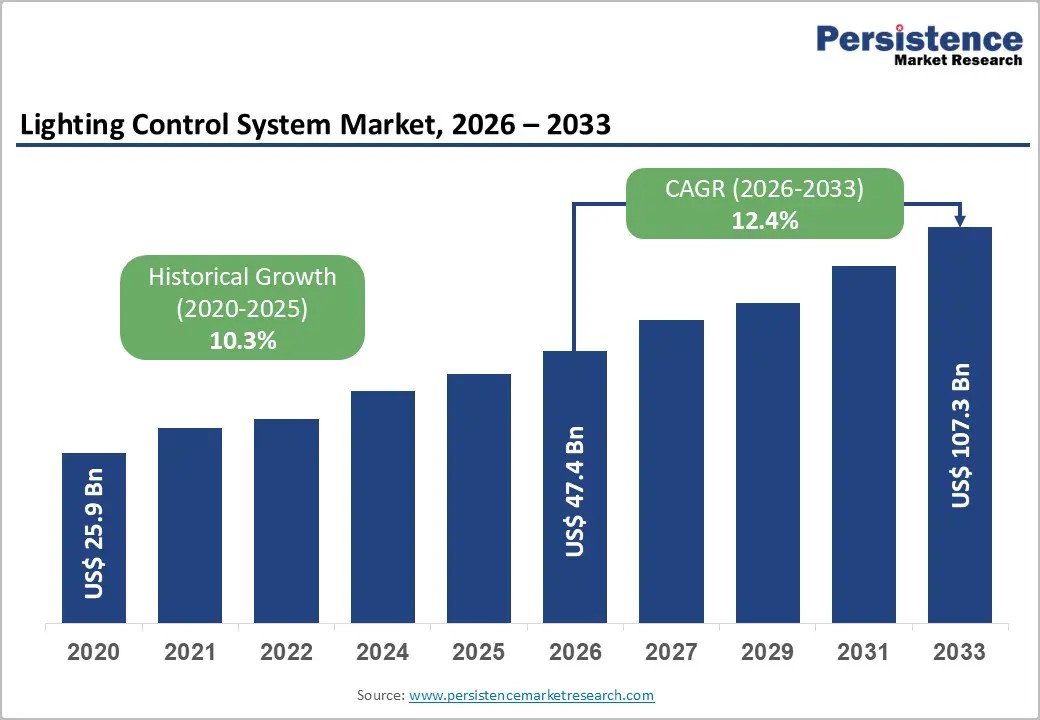
Lighting Control System Market is projected to grow from US$47.4 Bn in 2026 to US$107.3 Bn by 2033, expanding at a 12.4% CAGR, driven by smart lighting demand
BRENTFORD, ENGLAND, UNITED KINGDOM, June 24, 2026 /EINPresswire.com/ -- The global Lighting Control System Market is experiencing rapid transformation as buildings, cities, and industries shift toward intelligent energy management and automated infrastructure. Lighting control systems, which include sensors, controllers, gateways, software platforms, and connectivity modules, are becoming essential components of modern smart buildings. The market is projected to grow from US$ 47.4 billion in 2026 to US$ 107.3 billion by 2033, reflecting a strong CAGR of 12.4% during the forecast period. This expansion is primarily driven by tightening energy efficiency regulations, increasing adoption of smart city initiatives, and the integration of IoT and AI into building automation ecosystems.
A major growth catalyst for the Lighting Control System Market is the global push toward sustainable infrastructure and green building standards such as ASHRAE 90.1-2022, EU Ecodesign regulations, and California Title 24. These mandates require occupancy-based lighting, daylight harvesting, and automated dimming systems, making lighting control solutions a compliance necessity rather than an optional upgrade. Among product offerings, hardware dominates the market with over 52% share in 2026, driven by widespread deployment of sensors and controllers in commercial and industrial buildings. Regionally, Asia Pacific leads the global market with over 38% share, supported by rapid urbanization, large-scale smart city investments, and aggressive infrastructure expansion in countries like China and India.
𝐆𝐞𝐭 𝐚 𝐒𝐚𝐦𝐩𝐥𝐞 𝐏𝐃𝐅 𝐁𝐫𝐨𝐜𝐡𝐮𝐫𝐞 𝐨𝐟 𝐭𝐡𝐞 𝐑𝐞𝐩𝐨𝐫𝐭: https://www.persistencemarketresearch.com/samples/36671
Market Segmentation Analysis
The Lighting Control System Market is segmented by offering, technology, installation type, application, and region. Hardware leads due to its essential role in sensors, controllers, and gateways that enable automation and energy efficiency, while services are growing with rising demand for integration, maintenance, and cloud-based management. By technology, wired systems dominate because of reliability and security in large installations, whereas wireless systems are expanding rapidly due to IoT growth and easier retrofit deployment.
Retrofit installations hold the largest share as existing buildings upgrade to meet energy efficiency standards, while new installations are growing with smart building integration from the design stage. Commercial applications dominate due to high demand in offices, retail, hospitality, and institutions, while residential adoption is increasing with smart home trends. Regionally, Asia Pacific leads the market due to strong smart city investments, followed by North America with strict energy regulations and Europe driven by sustainability and net-zero targets.
Regional Insights
Asia Pacific leads the global Lighting Control System Market, supported by rapid urbanization, industrialization, and large-scale smart city deployments. China plays a central role with extensive smart infrastructure initiatives, while India’s ambitious smart city programs and LED modernization projects are significantly boosting demand. Japan and Southeast Asian countries are also investing in intelligent building systems as part of broader energy transition strategies. The region’s strong manufacturing base and government-backed infrastructure investments make it the fastest-growing and largest market globally.
North America holds a strong position in the market, driven by strict energy efficiency regulations such as ASHRAE 90.1, IECC standards, and California Title 24. The United States leads regional adoption due to widespread retrofit activity across commercial buildings and increasing deployment of connected street lighting systems under smart city programs. Strong technological adoption and the presence of leading industry players further reinforce regional growth.
Europe continues to be a key market, supported by aggressive decarbonization policies and stringent building energy efficiency regulations under the EU Ecodesign Directive and EPBD framework. Countries like Germany, the United Kingdom, and France are actively promoting smart lighting adoption through subsidies and energy efficiency incentives. The region’s strong focus on sustainability and net-zero goals is accelerating the integration of intelligent lighting control systems across residential, commercial, and public infrastructure.
𝐃𝐨 𝐘𝐨𝐮 𝐇𝐚𝐯𝐞 𝐀𝐧𝐲 𝐐𝐮𝐞𝐫𝐲 𝐎𝐫 𝐒𝐩𝐞𝐜𝐢𝐟𝐢𝐜 𝐑𝐞𝐪𝐮𝐢𝐫𝐞𝐦𝐞𝐧𝐭? 𝐑𝐞𝐪𝐮𝐞𝐬𝐭 𝐂𝐮𝐬𝐭𝐨𝐦𝐢𝐳𝐚𝐭𝐢𝐨𝐧 𝐨𝐟 𝐑𝐞𝐩𝐨𝐫𝐭: https://www.persistencemarketresearch.com/request-customization/36671
Market Drivers
The Lighting Control System Market is driven by rising energy efficiency mandates and strict green building regulations requiring occupancy-based lighting, daylight harvesting, and automated dimming in commercial buildings. Growing electricity costs and sustainability goals are also pushing organizations toward smart lighting adoption. Additionally, the rapid expansion of smart cities and IoT-enabled infrastructure is accelerating demand for connected lighting systems with sensors, AI analytics, and integration with building management platforms.
Market Restraints
High initial installation and equipment costs remain a major barrier, as lighting control systems require sensors, controllers, and software, making them more expensive than conventional lighting. System integration complexity and interoperability issues across protocols like DALI, Zigbee, KNX, and Wi-Fi also hinder large-scale adoption and increase deployment challenges.
Market Opportunities
Human-centric lighting powered by AI is creating strong growth opportunities by enabling adaptive brightness and color tuning based on occupancy and circadian rhythms. In addition, the integration of lighting systems with indoor positioning and analytics is transforming infrastructure into data-driven platforms, enabling new revenue streams through smart building services and occupancy insights.
𝐁𝐮𝐲 𝐍𝐨𝐰 𝐭𝐡𝐞 𝐃𝐞𝐭𝐚𝐢𝐥𝐞𝐝 𝐑𝐞𝐩𝐨𝐫𝐭: https://www.persistencemarketresearch.com/checkout/36671
Company Insights
The Lighting Control System Market is highly competitive with strong participation from global technology and building automation companies.
• Signify Holding
• Acuity Brands, Inc.
• Legrand S.A.
• Schneider Electric SE
• Lutron Electronics Co., Inc.
• Eaton Corporation plc
• Honeywell International Inc.
• Siemens AG
• ABB Ltd.
• ams-OSRAM AG
• Zumtobel Group AG
• Hubbell Incorporated
• Leviton Manufacturing Co., Inc.
• Cree Lighting USA LLC
Conclusion
The Lighting Control System Market is entering a strong growth phase driven by regulatory mandates, smart city development, and rapid adoption of IoT and AI-based building automation systems. As global infrastructure shifts toward energy-efficient and intelligent environments, lighting control systems are becoming a core component of modern building design rather than an optional upgrade. With robust growth across retrofit and new installations, expanding applications in commercial and residential sectors, and strong regional momentum led by Asia Pacific, the market is expected to more than double by 2033, creating significant opportunities for technology providers, integrators, and service-driven business models.
Related Reports:
Mobile Device Management Market
Pooja Gawai
Persistence Market Research
+1 646-878-6329
email us here
Visit us on social media:
LinkedIn
Instagram
Facebook
YouTube
X
Legal Disclaimer:
EIN Presswire provides this news content "as is" without warranty of any kind. We do not accept any responsibility or liability for the accuracy, content, images, videos, licenses, completeness, legality, or reliability of the information contained in this article. If you have any complaints or copyright issues related to this article, kindly contact the author above.
