

Latest Bus Rapid Transit System Market Research By The Business Research Company, Highlights Future Industry Trends
Bus Rapid Transit System Market
Bus Rapid Transit System Market analysis
Bus Rapid Transit System Market share
The Business Research Company’s Bus Rapid Transit System Global Market Report 2026 – Market Size, Trends, And Forecast 2026-2035
LONDON, GREATER LONDON, UNITED KINGDOM, October 27, 2026 /EINPresswire.com/ -- The bus rapid transit system market is evolving rapidly as cities worldwide seek efficient and sustainable transportation options. With growing urban populations and increasing traffic congestion, innovative transit solutions are becoming essential. Let’s explore the market’s size, key growth drivers, major players, and emerging trends that are shaping the future of bus rapid transit systems.
Growth Trajectory and Market Value of the Bus Rapid Transit System Market
The bus rapid transit system market is expected to gain more than $2.4 billion in value between 2025 and 2030. Among this growth, articulated buses and bi-articulated buses will each contribute approximately $1 billion, while traditional buses will add $0.4 billion. Leading global transportation infrastructure firms and specialized intelligent mobility companies are competing by focusing on advanced transit management, intelligent ticketing systems, dedicated corridor infrastructure, and integrated fleet management solutions. Central to their strategies are smart mobility technologies, sustainable public transportation approaches, and digital traffic management.
Request A Free Sample Of The Bus Rapid Transit System Market Report
https://thebusinessresearchcompany.com/sample_request?id=13166&type=smp&name=Bus%20Rapid%20Transit%20System%20Market%20Report%202026&utm_source=EINPresswire&utm_medium=Paid&utm_campaign=Oct_PR
How Next-Generation BRT Systems Are Revolutionizing Public Transport
Modern bus rapid transit networks are reshaping public transportation by delivering quicker, more reliable, and efficient service through dedicated lanes and infrastructure. For example, in November 2024, Metro introduced Metro Rapid, its BRT system in Cincinnati, aiming to improve travel times and accessibility. Enhancements such as dedicated bus lanes, upgraded stations, transit signal priority, and consistent service reliability have significantly enhanced the passenger experience and reduced journey durations.
Increasing Urban Traffic Congestion as a Market Growth Catalyst
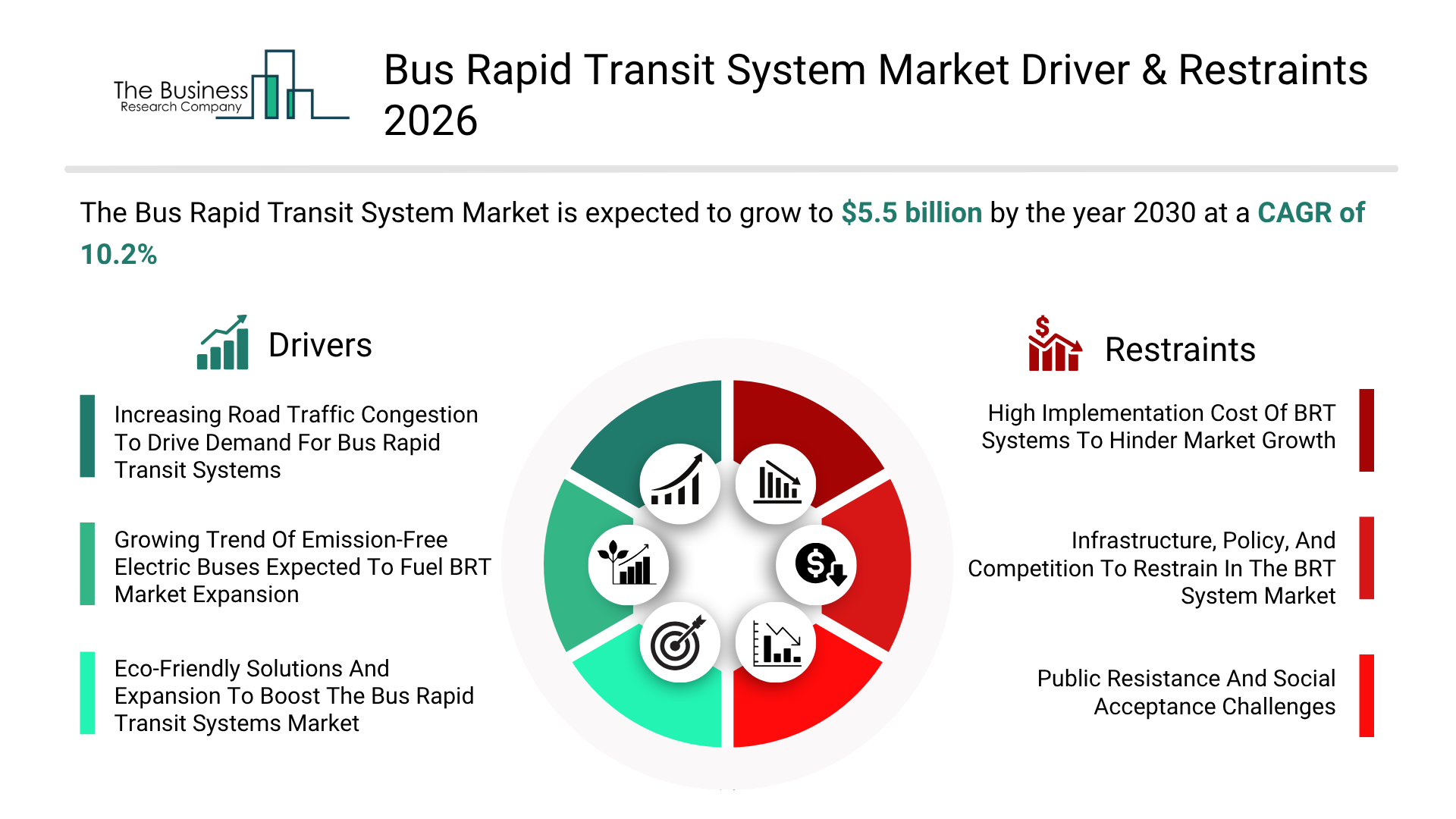
One of the main factors accelerating the bus rapid transit system market is the worsening traffic congestion in urban areas. With rising urbanization and more private vehicles on the road, city traffic networks are under substantial strain, causing longer travel times. Dedicated BRT lanes allow buses to avoid bottlenecks, providing faster and more dependable service capable of carrying large numbers of passengers efficiently. Governments often consider BRT systems a cost-effective alternative to rail transit, supporting an estimated 2.0% annual market growth from this factor.
Access The Detailed Bus Rapid Transit System Market Report Here
https://thebusinessresearchcompany.com/report/bus-rapid-transit-system-global-market-report?utm_source=EINPresswire&utm_medium=Paid&utm_campaign=Oct_PR
Rising Adoption of Emission-Free Electric Buses Boosting Market Demand
Another important growth driver is the increasing use of electric buses within BRT networks. Transit agencies are focusing on reducing greenhouse gas emissions and enhancing air quality, and electric buses help maintain high capacity and performance. Advances in battery technology, improved charging infrastructure, government subsidies, and environmental regulations are making electric fleets more practical. This trend is expected to contribute roughly 1.7% annual growth in the bus rapid transit market.
Expansion of Eco-Friendly Public Transport Networks Encouraging Market Development
Cities aiming to reduce carbon emissions and dependence on private cars are actively expanding and building new BRT corridors that connect residential, commercial, and industrial zones. Investments in green urban infrastructure across both developed and emerging markets support this expansion. This eco-conscious development is projected to provide about 1.3% yearly growth to the bus rapid transit system market.
Projected Market Size and Broader Industry Context by 2030
By 2030, the bus rapid transit system market is forecast to surpass $6 billion. It forms a small but significant segment of the larger Public Bus Services market, which is anticipated to reach approximately $388 billion by the same year. Within the vast Transport Services industry, expected to total $13,488 billion by 2030, bus rapid transit systems will represent nearly 0.04% of the overall value. The market is set to expand at a compound annual growth rate of 10% leading up to 2030.
Asia-Pacific Emerges as the Dominant Region in the Bus Rapid Transit System Market
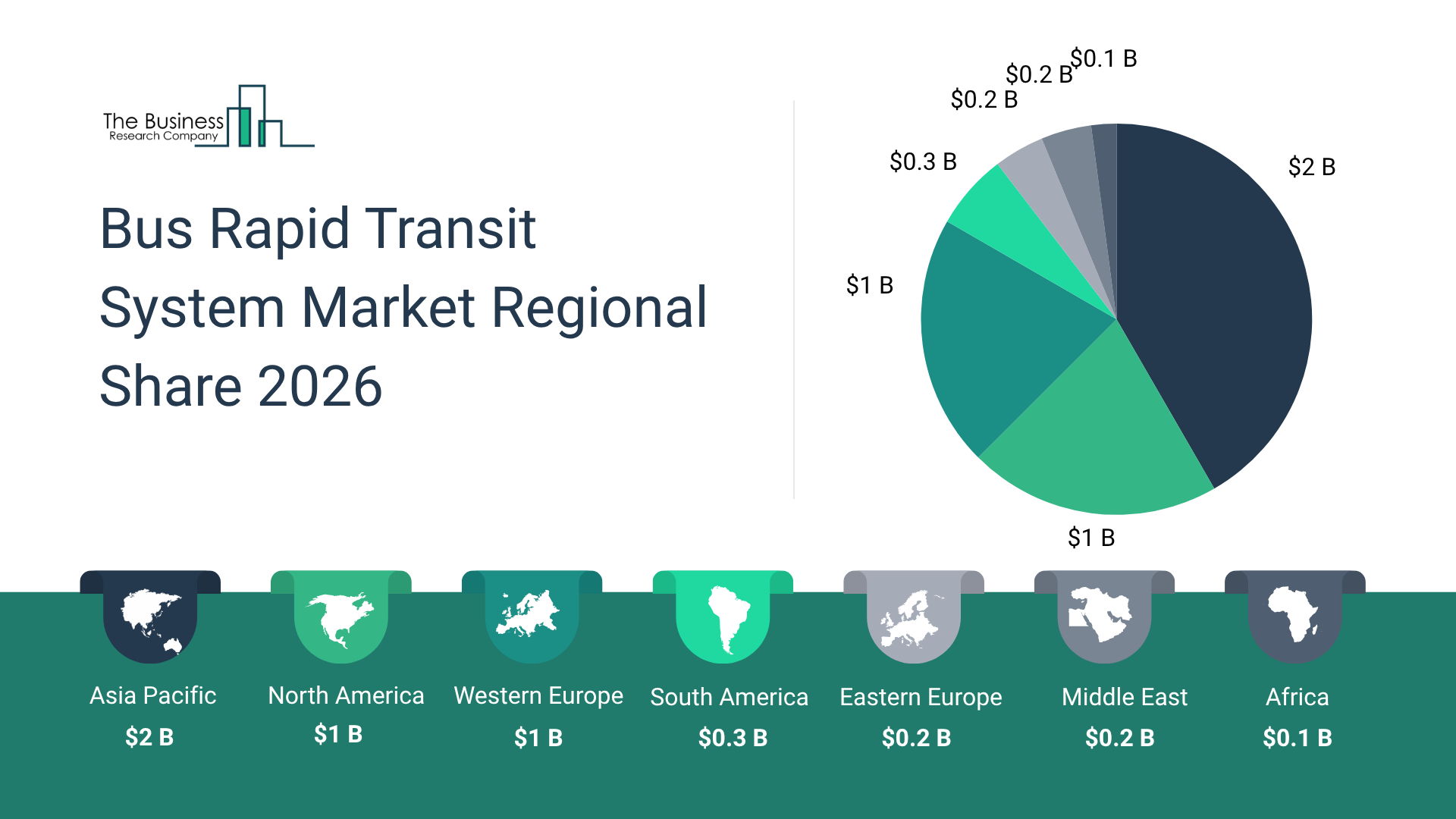
In 2030, Asia-Pacific is projected to be the largest regional market for bus rapid transit systems, with a value of $2.2 billion, rising from $1.3 billion in 2025 at a strong CAGR of 12%. This rapid expansion is driven by factors including swift urban population growth, heavy traffic congestion, substantial government investment in sustainable public transit, implementation of dedicated bus corridors, intelligent transportation systems, smart ticketing technologies, and significant urban mobility projects in countries such as China, India, Indonesia, and other Southeast Asian nations.
The United States Maintains a Leading Position in the Bus Rapid Transit Market
The USA is expected to be the largest single country market by 2030, reaching $1.2 billion up from $0.8 billion in 2025, growing at a 9% CAGR. This growth is supported by federal and state investments aimed at modernizing transit infrastructure, replacing aging bus fleets with dedicated BRT corridors, adopting electric and zero-emission buses, enhancing transit signal priority and real-time passenger information systems, and increasing focus on urban mobility, accessibility, and integrated multimodal transportation networks.
Articulated Buses Dominate Market Share in the Bus Rapid Transit System Sector
When categorizing the market by bus type, articulated buses are expected to hold the largest segment in 2030, accounting for 45% or $3 billion of the total market. This dominance stems from strong demand for high-capacity urban transit options, the availability of dedicated bus lanes in densely populated cities, preference for cost-effective alternatives to rail systems, and improvements in passenger comfort, accessibility, and operational efficiency. Expanding fleets to handle growing ridership further supports this segment’s growth.
Additional Market Segments by Seating, Service Level, Fuel Type, and End-Use
The bus rapid transit system market is further segmented by seating capacity into less than 50 seats, 50-80 seats, and above 80 seats. Service levels include express, semi-express, and local. Fuel types are classified as diesel, natural gas, and other fuel options. End-users are divided into government and private sectors, reflecting diverse demand sources within the market.
Leading Global Manufacturer Zhengzhou Yutong Group Shapes the Market
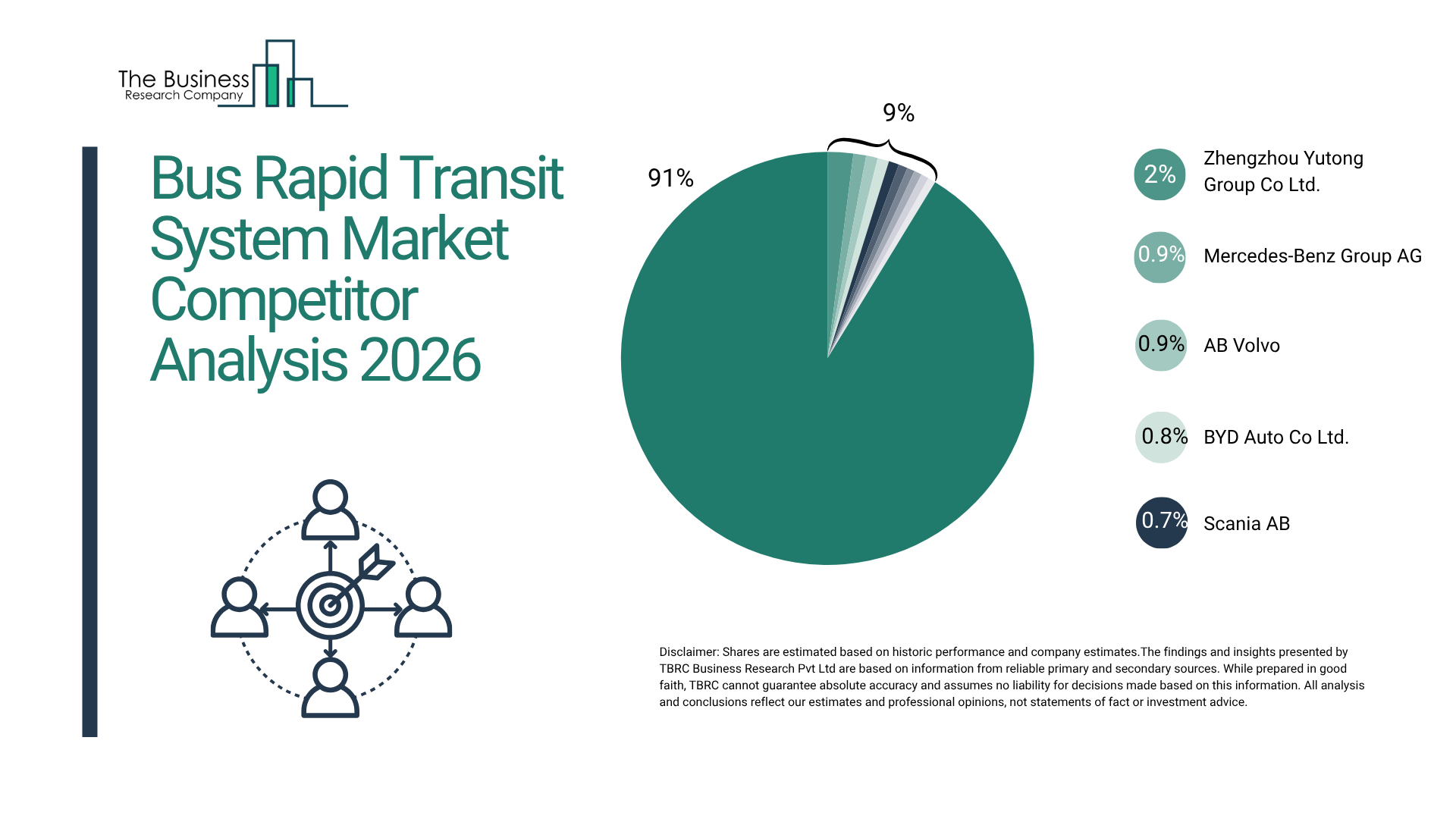
Zhengzhou Yutong Group Co. Ltd. held the top position globally by sales in 2025 with a 2% market share. Its bus manufacturing division supplies high-capacity buses, electric buses, intelligent transport vehicles, and transit mobility solutions tailored for urban public transit networks, dedicated bus corridors, and sustainable mass transit projects.
Prominent Players Competing in the Bus Rapid Transit System Market
Other major companies active in this sector include Mercedes-Benz Group AG, AB Volvo, BYD Auto Co. Ltd., Scania AB, Tata Motors Ltd., Iveco S.p.A., Marcopolo S.A., Solaris Bus & Coach sp. z o. o., New Flyer Industries Inc., Hino Motors Ltd., Xiamen King Long Motor Group Co. Ltd., Ashok Leyland Ltd., VDL Bus & Coach BV, Zhongtong Bus Holding Co. Ltd., Xiamen Golden Dragon Bus Co. Ltd., Transdev Group S.A., Anhui Ankai Automobile Co. Ltd., Ebusco BV, Gillig LLC, and Qingdao Hisense TransTech Co. Ltd.
Competitive Landscape and Market Structure Overview
The bus rapid transit system market is relatively fragmented, with the top ten companies accounting for just 9% of total revenue in 2025. Moderate entry barriers arise from infrastructure complexity, regulatory requirements, integration with intelligent traffic management, and the need for reliable, high-capacity urban systems. Leading firms maintain significant shares through diversified product portfolios, partnerships in public transportation, global manufacturing and distribution capabilities, and continuous innovation in high-capacity vehicles and intelligent transit technology. As demand for sustainable transit, electric buses, intelligent fleet management, and efficient urban mobility grows, these companies are expected to strengthen their positions through collaboration, technological advancement, and geographic expansion.
Market Share Breakdown of Leading Companies in 2025
Zhengzhou Yutong Group Co. Ltd. held a 2% market share in 2025, while Mercedes-Benz Group AG, AB Volvo, BYD Auto Co. Ltd., Scania AB, Tata Motors Ltd., Iveco S.p.A., Marcopolo S.A., Solaris Bus & Coach sp. z o. o., and New Flyer Industries Inc. each held around 1% market share.
Strategic Approaches Adopted by Market Leaders
To maintain a competitive edge, companies are focusing on upgrading bus rapid transit infrastructure to improve urban mobility and sustainability, adopting intelligent transportation technologies for better fleet management and passenger experience, expanding dedicated bus corridor networks to enhance accessibility and connectivity, and integrating smart mobility solutions to optimize fare collection and transit efficiency.
Key Suppliers, Wholesalers, and End Users in the Bus Rapid Transit System Sector
Major raw material suppliers for the market include steel and automotive component producers such as ArcelorMittal S.A., Nippon Steel Corporation, POSCO Holdings Inc., Tata Steel Limited, JSW Steel Limited, China Baowu Steel Group Corporation Limited, Hyundai Steel Company, JFE Steel Corporation, Nucor Corporation, SSAB AB, Voestalpine AG, and Gerdau S.A. Also significant are component suppliers like CRRC Corporation Limited, Knorr-Bremse AG, Wabtec Corporation, Cummins Inc., Allison Transmission Holdings Inc., Dana Incorporated, Michelin Group, Bridgestone Corporation, The Goodyear Tire and Rubber Company, Continental AG, Hitachi Astemo Ltd., Denso Corporation, and ZF Friedrichshafen AG.
Prominent wholesalers and distributors include WESCO International Inc., Rexel S.A., Sonepar Group, Graybar Electric Company Inc., Anixter International Inc., RS Group plc, Fastenal Company, Grainger Inc., Motion Industries Inc., Applied Industrial Technologies Inc., Wesco Distribution Inc., Border States Electric Supply, Codale Electric Supply Inc., Westburne Electric Supply, EECOL Electric Corporation, Nedco Electrical Group, City Electrical Factors Limited, Onninen Oy, Macnica Holdings Inc., Arrow Electronics Inc., Avnet Inc., Tech Data Corporation, Ingram Micro Holding Corporation, ScanSource Inc., and ALSO Holding AG.
End users span leading bus manufacturers and operators, including Volvo Bus Corporation, Daimler Buses GmbH, MAN Truck and Bus SE, Scania AB, Iveco Bus, Solaris Bus and Coach sp. z o.o., Alexander Dennis Limited, New Flyer Industries Canada ULC, Gillig LLC, BYD Company Limited, Yutong Bus Company Limited, Zhongtong Bus Holding Co. Ltd., King Long United Automotive Industry Co. Ltd., Ashok Leyland Limited, Tata Motors Limited, Eicher Motors Limited, Marcopolo S.A., Van Hool NV, VDL Bus and Coach BV, Anadolu Isuzu Otomotiv Sanayi ve Ticaret A.S., Otokar Otomotiv ve Savunma Sanayi A.S., Wrightbus Limited, NFI Group Inc., MCV Manufacturing Commercial Vehicles, and BMC Otomotiv Sanayi ve Ticaret A.S.
Future Growth Opportunities Across Bus Types and Market Drivers
The articulated, bi-articulated, and traditional bus segments are expected to provide the greatest growth opportunities, collectively adding more than $2.4 billion to the market by 2030. Specifically, articulated and bi-articulated buses will each increase by $1 billion, while traditional buses will contribute $0.4 billion from 2025 to 2030. Growth will be fueled by fleet electrification and alternative fuel adoption, demand for flexible and scalable mass transit solutions, public-private partnerships in urban transport, advanced fleet management and predictive maintenance technologies, efforts to reduce travel times through dedicated infrastructure, and fleet modernization initiatives to enhance reliability and performance. These trends reflect a strong focus on sustainable urban mobility, efficient public transport, and accessible high-capacity transit services.
Our latest 2026 market reports provide expanded strategic and visual intelligence with market attractiveness scoring and analysis, total addressable market (TAM) analysis, company scoring matrix graphics and tables, Excel-based forecasting dashboards, market hotspots infographics, key technologies and future trend analysis, together with updated graphics and tables.
Learn More About The Business Research Company
The Business Research Company (www.thebusinessresearchcompany.com) is a leading market intelligence firm renowned for its expertise in company, market, and consumer research. We have published over 30,000+ reports across 27 industries and 60+ geographies. Our research is powered by 1,500,000 datasets, extensive secondary research, and exclusive insights from interviews with industry leaders.
We provide continuous and custom research services, offering a range of specialized packages tailored to your needs, including Market Entry Research Package, Competitor Tracking Package, Supplier & Distributor Package and much more.
Disclaimer: Please note that the findings, conclusions and recommendations that TBRC Business Research Pvt Ltd delivers are based on information gathered in good faith from both primary and secondary sources, whose accuracy we are not always in a position to guarantee. As such TBRC Business Research Pvt Ltd can accept no liability whatever for actions taken based on any information that may subsequently prove to be incorrect. Analysis and findings included in TBRC reports and presentations are our estimates, opinions and are not intended as statements of fact or investment guidance.
Contact Us:
The Business Research Company
Americas +1 310-496-7795
Europe +44 7882 955267
Asia & Others +44 7882 955267 & +91 8897263534
Email: marketing@tbrc.info
Follow Us On:
LinkedIn: https://in.linkedin.com/company/the-business-research-company
Oliver Guirdham
The Business Research Company
+44 7882 955267
info@tbrc.info
Visit us on social media:
LinkedIn
Facebook
X
Legal Disclaimer:
EIN Presswire provides this news content "as is" without warranty of any kind. We do not accept any responsibility or liability for the accuracy, content, images, videos, licenses, completeness, legality, or reliability of the information contained in this article. If you have any complaints or copyright issues related to this article, kindly contact the author above.
